Network of fake Twitter accounts impersonating crypto security firms phish panicked victims

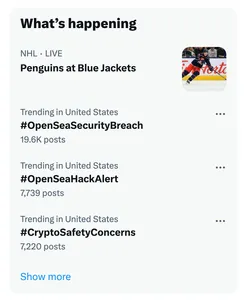
A screenshot of Twitter's trending topics sidebar, showing that #OpenSeaSecurityBreach, #OpenSeaHackAlert, and #CryptoSafetyConcerns were trendingTwitter trending topics on November 14 (attribution)
On the evening of November 14 I logged on to Twitter to notice that #OpenSeaHackAlert and related hashtags were trending. But they were trending not because OpenSea had truly been hacked, but because a huge network of fake accounts with usernames similar to those of PeckShield, CertiK, and zachxbt — well-known accounts that alert crypto traders to possible scams — were spamming the hashtag. Hoping to spark panic into crypto holders who had used the popular service, as well as other services like Uniswap which they were claiming were breached, the phishers shared links to sites that would supposedly help users revoke access to their wallets by those services, securing their assets. Instead, however, those malicious sites would drain the wallets.

According to researcher zachxbt, who himself was one of the impersonated, the scammers have stolen more than $300,000 in various assets using this technique.

This is not the first time such a technique has been used — a scammer attempted a similar, though less successful, scheme in April 2022. Scams like this take advantage of the poor UX in the crypto world for tracking and revoking wallet permissions that have been granted, requiring people to use third-party websites created for this purpose. Some of them are legitimate, but there are many malicious copies of these revocation sites that prey upon users who may be acting quickly in fear that their assets are at risk.

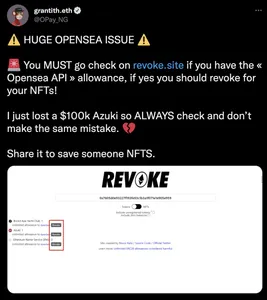
Scammer creates a fake site to revoke wallet permissions, then pretends there is an OpenSea vulnerability to trick people into using it

Tweet by grantith.eth, reading "HUGE OPENSEA ISSUE You MUST go check on revote.site if you have the OpenSea API allowance, if yes you should revoke for your NFTs! I just lost a $100k Azuki so ALWAYS check and don't make the same mistake. Share it to save someone NFTs.A tweet falsely claiming an OpenSea vulnerability, linking to a scam permission revocation website (attribution)
It's not exactly straightforward to revoke wallet permissions once they've been granted, and so many users use a site called revoke.cash to remove permissions in the case of malicious contracts or as a precautionary measure. A clever scammer created a fake website that mimics revoke.cash, called revoke.site, and then used a verified Twitter account to tweet about a "huge OpenSea issue" that they claimed resulted in the loss of a pricey NFT. Hoping that people would panic and try to use the site to revoke permissions, in reality the website runs a script to determine the highest value assets, and then prompts the user to "revoke" permissions for those assets — when in reality, it sets approval for those assets to be transferred to the scammer's wallet. As of the evening of April 7, the wallet had received 13 NFTs, and flipped eight of them for a total profit of 4.9 ETH (~$16,000).

No JavaScript? That's cool too! Check out the Web 1.0 version of the site to see more entries.